
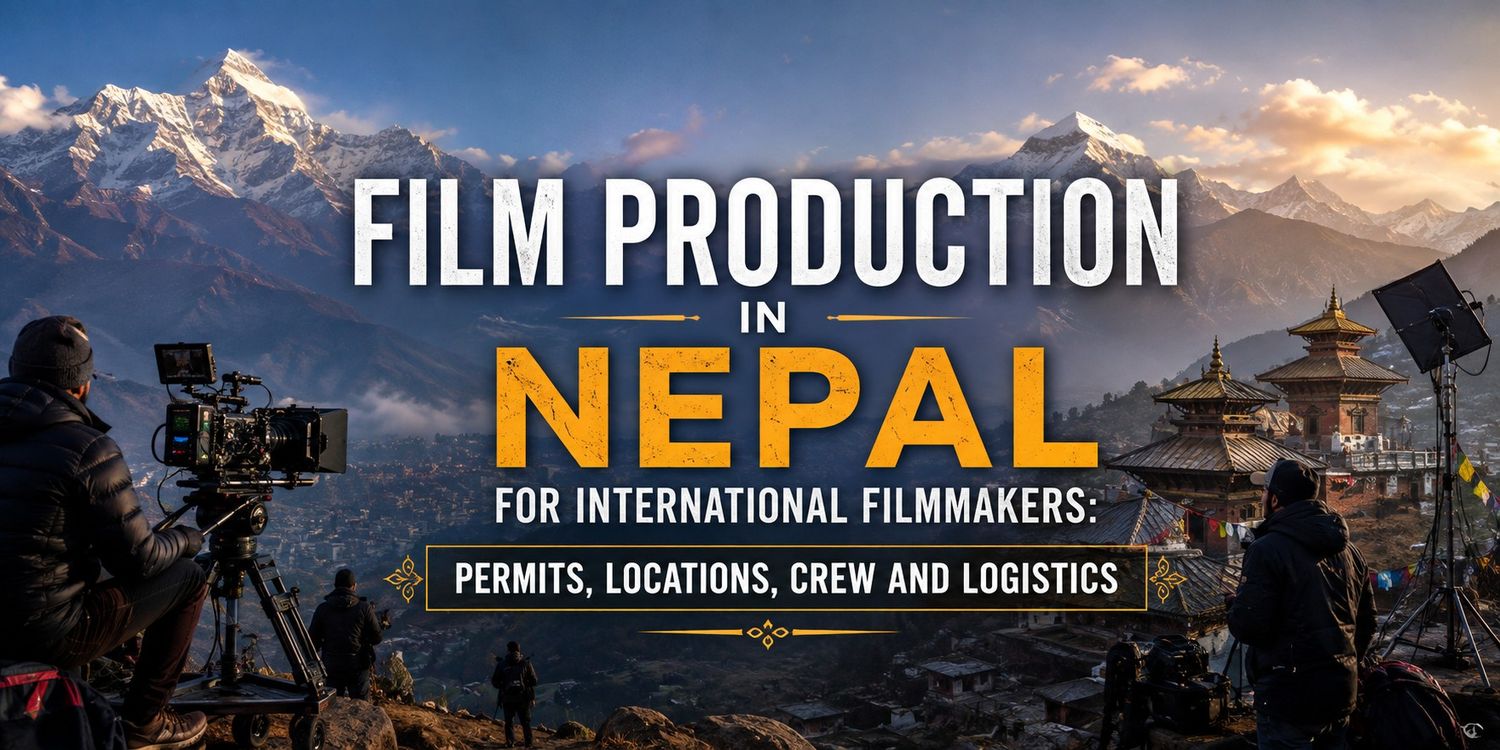
Film production in Nepal is open to international crews from Europe, North America and elsewhere, but it runs through a formal permit process, a mandatory local coordinator and its own set of logistics that visiting productions need to plan for well in advance. That’s the short version. The rest of this guide is everything a production team from London, Los Angeles, Toronto, Berlin, or anywhere else needs to know before they book flights.
This is where a lot of first-time productions run into friction not because Nepal is difficult to work in, but because the process is unfamiliar. That’s exactly the gap Fixer in Nepal was set up to close: acting as the local coordinator every foreign crew is legally required to have and handling permits, crew, locations and logistics so a visiting team can focus on the shoot itself.
Quick Answer: Can International Filmmakers Shoot in Nepal?
Yes. International filmmakers, including crews from the US, Canada, the UK and the EU, can film in Nepal, but every professional shoot needs a government filming permit and foreign productions must apply through a Nepal-registered local coordinator rather than directly.
At a glance, here’s what a foreign production needs to plan for:
- A government filming permit (mandatory for all professional shoots)
- A Nepal-registered local coordinator or production company to submit the application
- A tourist visa (available on arrival for most nationalities, including the US, Canada, UK and EU)
- A separate drone permit, if aerial footage is planned
- Additional clearance for national parks or UNESCO heritage sites, where relevant
- A local crew and fixer team for logistics, translation and cultural navigation
Filming Permits in Nepal: What International Crews Need to Know
The Ministry of Communication and Information Technology (MoCIT) issues Nepal’s national filming permit, covering most locations outside protected areas. The Film Development Board Nepal, under the same ministry, reviews applications and issues a formal letter of guarantee once a shoot is cleared. Some productions are also assigned a government liaison officer who accompanies the crew and helps resolve issues with local authorities on the ground.
The rule that catches almost every first-time production off guard: foreign crews cannot apply for a Nepal filming permit directly. The application has to go through a local coordinator or a Nepal-registered production company such as Fixer in Nepal on the crew’s behalf.
A typical filming permit application needs:
- A project description of what you’re filming and why.
- A full crew list with passport numbers for everyone traveling.
- A day-by-day shooting schedule, including all planned locations.
- An equipment list with values and serial numbers (this also serves as your customs declaration).
- A letter from your local coordinator addressed to the Ministry.
Simple, single-location shoots typically clear within about a week. Multi-location productions, or anything touching a national park or heritage site, can take 30 days or more especially if the Ministry requests an additional consent letter from the Department of Archaeology, which applies to locations like Kathmandu Durbar Square, Bhaktapur, Boudhanath, or Lumbini.
For crews flying in from Europe or North America, the practical takeaway is timing: file for permits well before you book non-refundable flights, since permit approval and travel booking don’t move at the same speed.
Visas for Film Crews from Europe and North America
Most crew members from Europe and North America can get a Nepal tourist visa on arrival at Tribhuvan International Airport in Kathmandu, separate from the filming permit itself. As of 2026, visa on arrival is available to travelers from the US, Canada, the UK and all EU member states, along with most other nationalities and costs USD 30 for 15 days, USD 50 for 30 days, or USD 125 for 90 days, with all three options allowing multiple entry.
A few things worth knowing before you travel:
- Your passport needs at least six months of validity remaining.
- Bring a passport-style photo for the visa form and payment in USD or another accepted foreign currency (not Nepali rupees).
- An online visa application through Nepal’s eVisa portal in advance can shorten the airport queue.
- The tourist visa is separate from your filming permit; you’ll need both and the filming permit process is what your local coordinator manages on your behalf.
- Extensions are available if a shoot runs long, but they need to be handled before your current visa expires.
None of this replaces the filming permit. A crew can hold a valid tourist visa and still not be legally cleared to film without the separate Ministry approval, a distinction that trips up more first-time productions than almost anything else on this list.
Drone Permits for Aerial Filming
Aerial footage requires a separate approval on top of your standard filming permit. Drone operations in Nepal are overseen by the Civil Aviation Authority of Nepal (CAAN) and a drone permit application needs details on your drone model, flight zones and planned days of operation. Approvals move slower near airports, military installations and national parks and some protected areas ban drone use outright regardless of permit status so this is worth confirming before an aerial shot goes into your shot list.
Where to Film: Locations for International Productions
Nepal’s appeal for international crews comes down to how much visual variety sits within a short travel radius. A few of the location categories that come up most often for foreign productions:
Kathmandu Valley Newari architecture, temple courtyards, dense urban texture and UNESCO World Heritage Sites like Kathmandu Durbar Square, Bhaktapur, Patan and Boudhanath. Filming inside heritage sites usually requires an added consent letter from the Department of Archaeology.
The Himalaya and trekking regions Everest (Sagarmatha), Annapurna and Langtang regions offer some of the most recognizable mountain landscapes in the world, but they come with altitude logistics, limited infrastructure and, in protected areas, separate park clearance and conservation fees.
The Terai lowlands Chitwan National Park and the surrounding plains offer wildlife filming and a very different visual palette from the mountains, with their own park permit requirements.
Rural hill villages Gorkha, Bandipur and similar towns offer authentic rural Nepal without the logistics of high-altitude shooting, useful for documentary and narrative work that doesn’t need mountain backdrops.
A location scout familiar with permit boundaries, seasonal access and community relationships saves a foreign production real time here which is one of the services Fixer in Nepal typically handles before a crew even lands.
Hiring Local Crew and Fixers in Nepal
A local fixer does more than translate; they read the situation a foreign crew can’t, from which official to approach first to which shot might be culturally inappropriate before it’s too late to change.
For a production from Europe or North America, the practical benefits of hiring local crew go beyond language:
- Existing relationships with local authorities, village leaders and heritage site staff
- Familiarity with realistic timelines what “next week” actually means in a given region
- The ability to flag cultural or religious sensitivities before they become a problem on camera
- Local knowledge of weather patterns, road conditions and altitude-related risks
- Established networks of camera assistants, sound recordists, drivers and translators
Fixer in Nepal works specifically with this kind of visiting production acting as the legally required local coordinator for the Ministry application and building out the rest of the crew from a roster of vetted local professionals who’ve worked with foreign documentary, commercial and news teams before.
Getting to Nepal: Flights from Europe and North America
There are no direct flights to Kathmandu from North America and very few direct routes from Europe, so most international crews connect through a major hub. Common routing includes:
- From Europe: Connections via Doha (Qatar Airways), Istanbul (Turkish Airlines), or Abu Dhabi (Etihad), landing at Tribhuvan International Airport (Kathmandu).
- From North America: Typically a transatlantic or transpacific connection through the Gulf, Europe, or East Asia, since there’s no direct North America–Kathmandu route.
- Domestic flights within Nepal: Regional airports like Lukla, Pokhara and Bharatpur connect Kathmandu to trekking and wildlife regions, though mountain flights are frequently weather-delayed, so buffer days matter.
Because of connection times and potential weather delays on the Nepal end, most experienced producers build at least one full buffer day into arrival and departure schedules before committing to a tight shooting calendar.
Equipment, Customs and Insurance
Your equipment list isn’t just a packing list for a Nepal shoot, it doubles as your customs declaration, so it needs to be accurate down to serial numbers, values and country of origin. A few things international crews consistently underestimate:
- Battery life drops fast at altitude. Cold temperatures drain batteries quickly above 3,000 meters and recharging options are limited in remote regions.
- Backups matter more here than at home. Replacing a failed hard drive or damaged lens isn’t a same-day fix outside Kathmandu.
- Insurance is typically required, not optional. Most permit applications ask for proof of coverage and given the altitude, remote terrain and monsoon risk, it’s worth having regardless.
- Carnet documentation helps at customs. An ATA Carnet, common for productions from the US, UK and EU, can simplify bringing expensive equipment in and back out again.
Nepal Film Production Budget for International Crews
There’s no fixed cost for filming in Nepal; budgets depend heavily on crew size, number of locations, permit complexity and whether the shoot involves altitude or protected areas. The main cost drivers for most international productions are:
| Shoot Type | Permit Complexity | Crew Size Needed | Primary Cost Driver |
| Urban/cultural (Kathmandu Valley) | Low–Medium | Small | Heritage site consent fees |
| Trekking/mountain documentary | Medium–High | Small, altitude-trained | Domestic flights, park fees |
| Wildlife (Chitwan/Terai) | Medium | Small–Medium | Conservation fees, guide requirements |
| Multi-region documentary | High | Medium | Cumulative permits + logistics time |
A lean crew director, DP, sound recordist, plus one or two local fixers is usually more cost-effective than flying out a full crew from home, since local hires already know the terrain, the officials and the language. Domestic flights, teahouse-style accommodation in trekking regions and weather-related schedule buffers are recurring line items that tend to surprise first-time productions from Europe and North America.
Nepal’s Seasons and When to Shoot
Nepal’s seasons affect regions differently and picking the right window matters more for mountain shoots than urban ones:
- Pre-monsoon (March–May): Clear mornings, with haze building by midday.
- Monsoon (June–September): Heavy rain and poor high-altitude visibility, though Kathmandu Valley and the Terai remain workable.
- Post-monsoon (October–November): Generally the strongest window for mountain and trekking documentaries, with clear skies and strong Himalayan visibility.
- Winter (December–February): Cold but clear at altitude, though some high mountain passes may close.
If altitude is part of the shoot, build in acclimatization time for crew and talent rushing this is one of the most common scheduling mistakes foreign productions make.
Cultural Protocols for Foreign Crews
A filming permit doesn’t override local custom. Explicit consent is required before filming inside any monastery, temple, or private ceremony, since some rituals or interiors may be off-limits regardless of paperwork. In rural areas, it’s best to be introduced by a respected local contact before filming starts and to pay your subjects fairly for their time.
Common Mistakes International Productions Make in Nepal
- Applying for filming permits too late in the planning process
- Assuming a filming permit automatically covers drone use
- Choosing the cheapest local coordinator instead of the most experienced one
- Underestimating altitude acclimatization time
- Scheduling mountain shoots during monsoon season
- Confusing the tourist visa with the filming permit and assuming one covers the other
Key Takeaways
- Nepal is open to international documentary, commercial and film production, but every professional shoot needs a government filming permit.
- Foreign crews, including those from Europe and North America, must apply through a Nepal-registered local coordinator like Fixer in Nepal direct applications aren’t accepted.
- A tourist visa on arrival covers travel, not filming; the filming permit is a separate legal requirement.
- Drone filming needs a separate CAAN permit on top of the core filming permit.
- Post-monsoon (October–November) is generally the strongest window for mountain and trekking shoots.
- Budget for permits, your coordinator’s fee, insurance, domestic flights and weather buffers, not just crew and gear.
Frequently Asked Questions
Can filmmakers from the US, UK, Canada, or Europe legally film in Nepal?
Yes. International crews from Europe and North America can film in Nepal, but every professional shoot requires a government filming permit obtained through a Nepal-registered local coordinator.
Do I need a visa to film in Nepal and is it the same as the filming permit?
No, they’re separate. Most travelers from the US, Canada, the UK and the EU can get a Nepal tourist visa on arrival, but that only covers travel; a filming permit is a separate requirement issued through the Ministry of Communication and Information Technology.
Can I apply for a Nepal filming permit myself as a foreign producer?
No. Foreign crews must apply through a local coordinator or a production company registered in Nepal, such as Fixer in Nepal, who submits the application and takes on compliance responsibility during the shoot.
Is drone footage covered under a standard Nepal filming permit?
No. Drone operations require a separate approval from the Civil Aviation Authority of Nepal (CAAN) in addition to the standard filming permit.
What’s the best time of year for an international crew to film in Nepal’s mountains?
Post-monsoon, from October through November, generally offers the clearest skies and most stable weather for high-altitude filming.
How long does the Nepal filming permit process take for an international production?
Simple, single-location shoots typically clear in about a week. Multi-location or protected-area shoots can take 30 days or more, so international crews should apply well ahead of travel dates.
Do international productions need to hire local crew in Nepal?
It’s not always legally required for smaller shoots, but it’s strongly recommended. A local fixer and crew reduce cultural missteps, speed up logistics and are mandatory in practice for permit compliance, since your local coordinator effectively acts as your legal point of contact.
Conclusion
Nepal is open to international filmmakers; the permits, visas, and local coordination just need to be planned for, not left as an afterthought. Get the paperwork moving early, build in weather and altitude buffers, and bring in people who already know the terrain. That’s the whole job at Fixer in Nepal: we handle the permits, crew, and logistics so your team can focus on getting the shot.
To start your permit application or plan a shoot, contact Fixer in Nepal.